What Happens If You Stop Paying Timeshare Maintenance Fees?
Understanding the Potential Consequences and what to consider before making that decision.
Stopping maintenance fee payments is one of the most common questions Timeshare Counsel LLC hears from owners who feel financially stuck. The answer is rarely simple. The consequences can reach further than most owners expect.
This article explains what typically happens when fees go unpaid, the factors worth understanding before making that decision, and the alternatives that may be available depending on an owner's specific situation.
Stopping payment feels like taking back control. But the financial and legal consequences that follow can create a bigger problem than the fees themselves. Understanding those consequences before acting is the most important first step.
What Maintenance Fees Are and Why They Don't Stop
Timeshare maintenance fees are annual charges that fund the ongoing operating costs of the resort: landscaping, utilities, insurance, staffing, repairs, and property reserves. They are not optional line items. They are binding contractual obligations tied to the ownership interest itself.
Unlike a gym membership that can simply be cancelled, timeshare ownership is a real property interest in most cases. That distinction matters because the obligations that come with it, including maintenance fees, do not end when an owner decides to stop paying. They continue until the ownership is formally transferred, released, or resolved through a documented process.
Fees have also generally trended upward year over year. Most contracts include no cap on future increases, and special assessments for major repairs or improvements can add unpredictable costs on top of the base fee. This is a significant part of why owners seek to exit, and why the financial pressure to stop paying can feel urgent.
The obligation doesn't pause when payments stop. Late charges, collection activity, and potential foreclosure proceedings can all begin while the underlying contract remains in force. What feels like a temporary solution can quickly compound into a larger financial problem.
What Typically Happens When Payments Stop
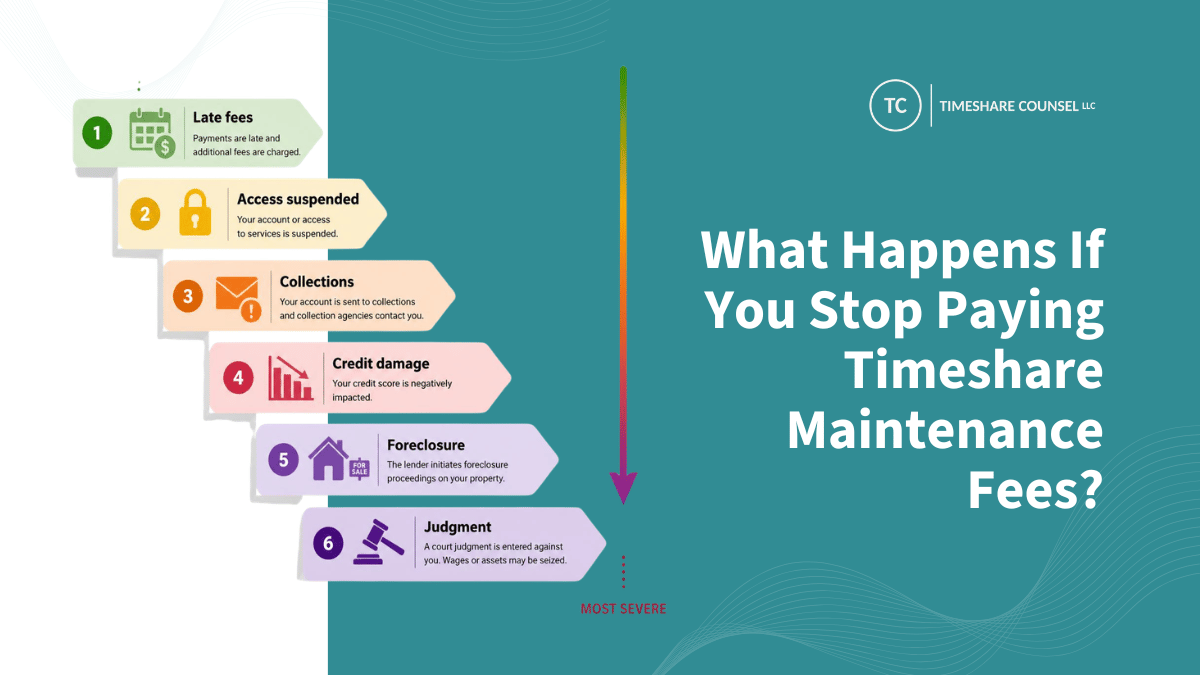
The sequence of events after missed maintenance fee payments is fairly consistent, though the exact timeline and consequences depend on the resort, the state where the property is located, and the specific terms of the contract.
| 01 | Late fees start adding up. | Most contracts allow the resort to begin charging late fees shortly after a missed payment. The rate varies by contract and state, but it can add meaningfully to the balance owed over time. |
| 02 | Your access gets cut off. | Use rights are typically suspended when fees go unpaid. The owner loses access to reservations, exchange programs, and other benefits tied to the ownership. |
| 03 | The debt goes to collections. | Resorts commonly turn delinquent accounts over to collection agencies. Once in collections, the unpaid balance may be reported to the major credit bureaus, where negative marks can remain for a number of years. |
| 04 | Your credit score takes a hit. | A reported delinquency can lower an owner's credit score, affecting their ability to borrow at favorable rates or secure future financing. The damage can take years to recover from. |
| 05 | Foreclosure becomes a real possibility. | Depending on the state and the contract structure, persistent nonpayment can expose an owner to foreclosure proceedings on the timeshare interest. Foreclosure carries its own costs and credit consequences separate from the original missed fees. |
| 06 | A court judgment may follow. | In some cases, resorts pursue a money judgment instead of, or in addition to, foreclosure. A judgment can allow the resort or its assignee to pursue wage garnishment or bank levies depending on state law. |
Not every nonpayment situation leads to foreclosure. The risk is real and depends heavily on the resort, the state, and the contract terms. Assuming the resort won't pursue action is a significant gamble.
Questions to Ask Before Deciding to Stop Paying
Before stopping maintenance fee payments, owners are better served by getting clear answers to a set of specific questions. These are not rhetorical questions. Each one can materially affect what actually happens next.
The specific consequences, including late fee rates, cure periods, and foreclosure timelines, are typically spelled out in the contract. Reading that language carefully before taking action is the starting point for any decision.
State law governs timeshare foreclosure procedures, collection rights, and credit reporting obligations. The consequences of nonpayment in Florida differ meaningfully from those in Nevada, Tennessee, or California. The state where the resort is located, not where the owner lives, typically controls.
Some resorts have internal programs, both formal and informal, for owners who can document genuine hardship. Others do not. Knowing which situation applies before stopping payments can open or close options.
If there were representations made during the original sales process that affected the ownership decision, those concerns may be relevant to how the situation can be addressed. Stopping payments without surfacing those concerns means losing a potential avenue.
The credit impact of a timeshare delinquency depends on whether the resort reports to credit bureaus, when they report, and the current state of the owner's credit profile. For some owners, the impact is manageable. For others, especially those planning to apply for a mortgage or major financing, it can be significant.
Developer deed-back programs, voluntary return programs, and structured exit processes exist for some ownerships under certain conditions. Stopping payments before exploring these options can actually make a formal exit harder to achieve, not easier.
Stopping payments is not the same as exiting a timeshare. In most cases, it creates a delinquent ownership rather than ending one. An owner who has stopped paying still owns the timeshare. They just owe money on top of it. Understanding that distinction before acting is critical.
Alternatives Worth Understanding First
The most common alternatives to stopping payments outright fall into three categories. None of them are guaranteed. They all depend on the specific ownership, resort, and circumstances. But each is worth understanding before making a decision that carries irreversible credit and legal consequences.
Developer programs
Many major timeshare developers have voluntary return or deed-back programs that allow qualifying owners to transfer the ownership back to the resort under documented conditions. Qualifying criteria vary and are set by the developer. Owners who contact the resort directly, or work with a company that has experience navigating these programs, may find pathways that aren't publicly advertised.
Hardship negotiation
Some resorts will negotiate adjusted payment arrangements with owners who can document genuine financial hardship. This is not universal, and it does not end the ownership. But it may delay or reduce the consequences of nonpayment while a longer-term exit is being pursued.
Structured exit through a documented review
A structured review of the ownership, including the original contract, how the sale was conducted, what the owner was told, and what documentation exists, can surface information that affects exit options. This is especially relevant when the original sale involved representations that may not have been accurate or complete.
Timeshare Counsel LLC does not advise owners to stop making payments on any financial obligation. The approach is to review the ownership documentation, the original sales circumstances, and the resort's policies, then coordinate a structured resolution process based on what the facts actually support. The goal is to avoid advising a course of action that creates new financial exposure while leaving the ownership unresolved.
What Timeshare Counsel LLC Can and Cannot Do
What owners typically ask, and how Timeshare Counsel LLC approaches each question
Timeshare Counsel LLC cannot unilaterally stop maintenance fee obligations. No exit company can. What Timeshare Counsel LLC does is review the ownership and coordinate a structured process to pursue the pathway most appropriate based on the documented facts. The resort or developer issues any final release or transfer documentation.
No specific outcome can be guaranteed. The resort or developer makes the final decision. Timeshare Counsel LLC brings attorney-owned leadership, resort-specific experience, and a structured, documented process to help owners present their situation clearly and pursue the pathway that appears most appropriate based on the facts. Those factors can support a more organized process, but they do not guarantee a specific result.
Timeshare Counsel LLC does not advise owners to stop making payments on any financial obligation. Stopping payments while a structured exit is being pursued can complicate the process, affect credit standing, and in some cases reduce the options available. The review process does not require payment stoppage as a step.
Timeshare Counsel LLC reviews ownership documentation, original contract terms, the circumstances of the sale, and resort-specific policies. Based on that review, the team identifies which exit pathways may apply and coordinates the process internally. The same case team remains involved from intake through resolution.
Timeshare Counsel LLC is attorney-owned and operated. Its co-founder is a licensed California attorney whose background shapes the company's standards and process discipline. That ownership structure makes it possible to coordinate every stage of the process, including deed and title coordination, within one accountable team, without handing work off to outside vendors at the stages that matter most.
Stopping payments doesn't end the ownership.
Understanding what it does start, and what else might be possible, is where a real decision begins.
Not sure what your options actually are?
Timeshare Counsel LLC reviews ownership documentation and coordinates a structured exit process based on your specific facts, without advising you to stop payments or take actions that create new financial risk.
Start With an Ownership ReviewKE-010: Timeshare Exit FAQ: Answers to the Questions We Hear Most
A plain-English reference covering the questions owners ask most often, organized by topic so you can find what applies to your situation.
Legal Disclaimer: This article is for general informational purposes only and does not constitute legal advice. Timeshare Counsel LLC is not a law firm and does not provide legal advice or legal representation under the Timeshare Counsel LLC name. No attorney-client relationship is created by your use of this website, this article, submitting a contact form, or engaging Timeshare Counsel LLC. Every situation is unique; outcomes depend on specific facts, documentation, resort or developer policies, and applicable law, and no specific outcome is guaranteed. Timeshare Counsel LLC does not advise owners to stop making payments on any financial obligation.